Hand-assembled booklets for pleasure and contemplation
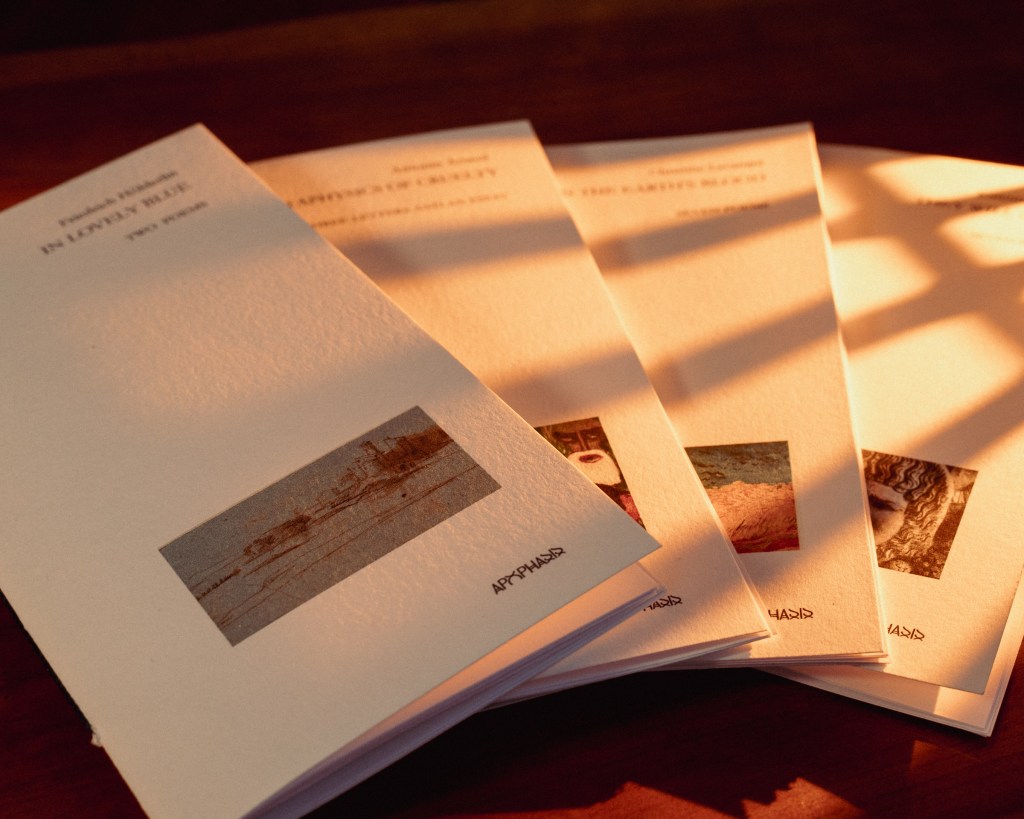
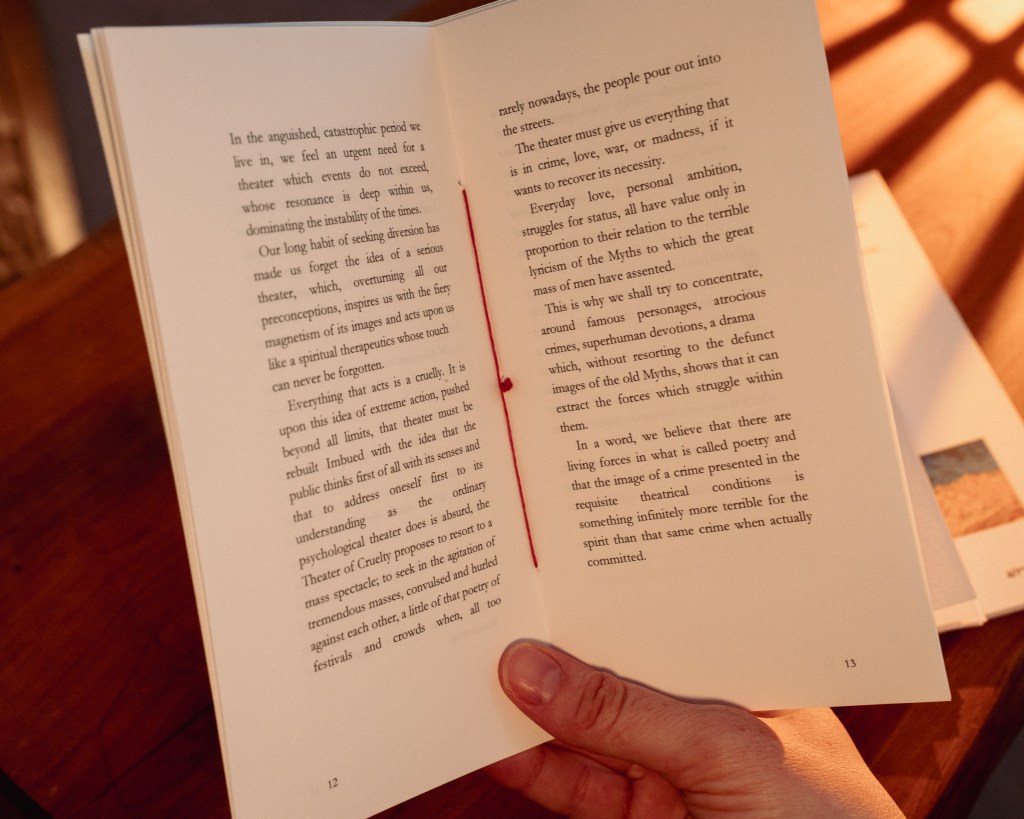
Apophasis publishesshort texts (16-36 pages) on high quality paper cut to roughly 4.25 x 7.75 inches. We say “roughly” because each individual item is hand-assembled. We are animated by DIY, minimalist, and simple-technology values. (See samples here.) You will not find us on Amazon, Instagram, or any other social media platform. Outside of the occasional serendipitous stumble over this website, we depend on word of mouth.
What do we publish? The subjects of our booklets include essays on literature, philosophy, art, and social critique. We are especially fond of moody German poetry. Creating fresh translations from that language is one of our passions. Some of our booklets feature well-known writers, but we also publish work by writers past and present of whom you have probably never heard. We strive to create objects for the reader’s enjoyment, contemplation, and edification. Our goal is to create booklets that you desire to hold in your hands, and read over and over again.
All booklets are $12 The price includes shipping and handling from within the continental U.S. Please contact us with orders from elsewhere.
Booklets
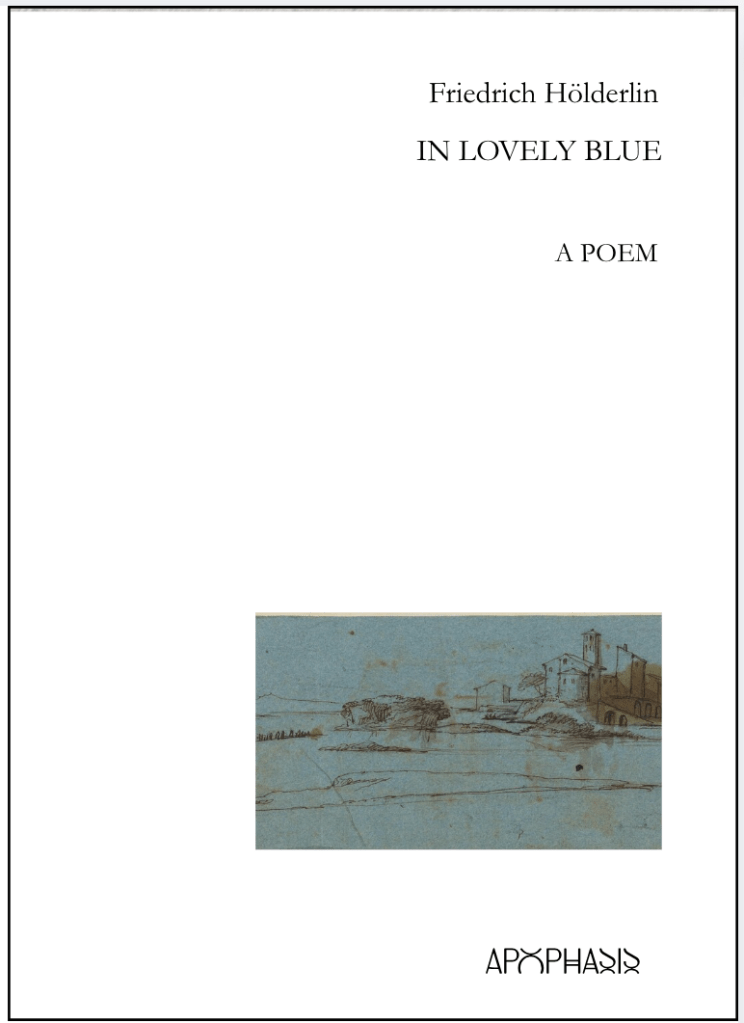
FRIEDRICH HÖLDERLIN
IN LOVELY BLUE: A POEM
4.25 x 7.75 inch CORD-stitched booklet • 13 pages • $12 •ORDER new english translation FACING original German texT
In lovely blue the steeple blooms with its metal roof
Found scrawled on a sheet of paper by a visitor to his Tübingen tower, “In Lovely Blue” is Friedrich Hölderlin’s (1770-1843) achingly beautiful testament to a life of poetic yearning. In this time of trouble, we may turn to Hölderlin when we find “no” on our lips. For he, too, yearned deeply for a more humane, satisfying world. He may have modeled his world on idiosyncratic notions of ancient Greece. But he knew better than to be snookered by utopian fantasies. For a poem, he insists, “naive in appearance, is heroic in its significance. It is the metaphor of great aspirations.”
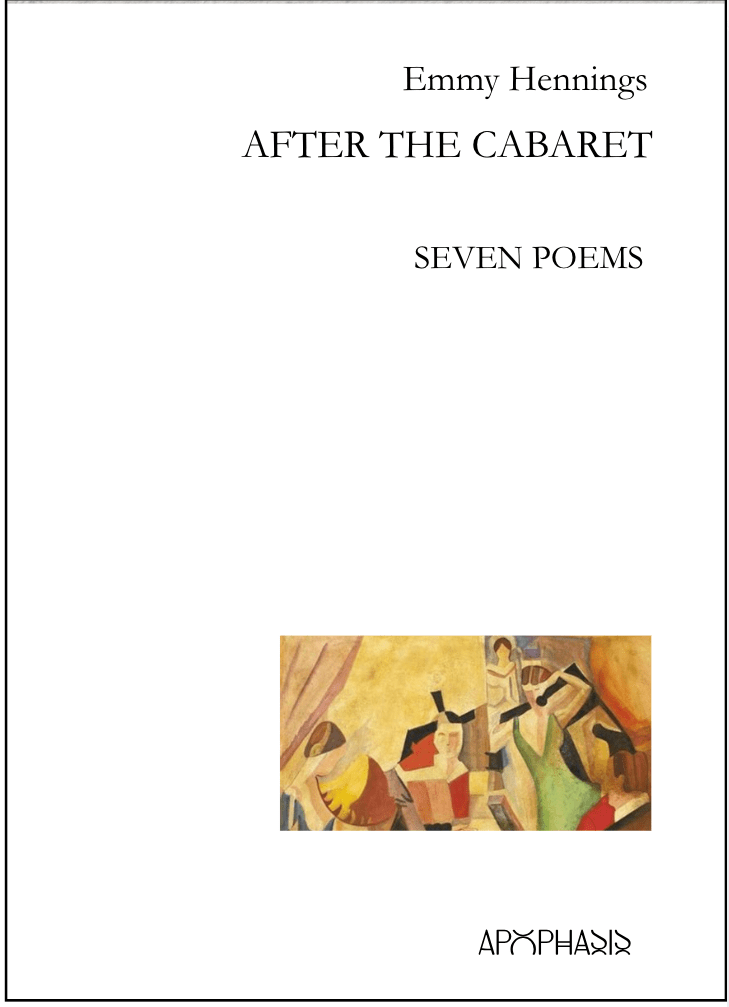
EMMY HENNINGS
AFTER THE CABARET: SEVEN POEMS
4.25 x 7.75 inch CORD-stitched booklet • 17 pages • $12 • ORDER new english translations FACING original German text
Love me pure of all my sins
Her life was wracked by material lack, psychological struggles, drugs, prostitution, illness, and even prison. Yet, here she was! Emmy Hennings (1885-1948), the grand diseuse, the life and soul of whatever was going on, “the star of so many nights of cabarets and poems!” (Züricher Post), Emmy Hennings — “shocking the audience when she sang Hugo Ball’s Totentanz (Dance of Death), arousing it when she lent her body to verses, entertaining it with ballads by Wedekind, chansons by Aristide Bruant, or Danish folk songs, and calming it by reading prose texts.” — Kunsthaus. Hennings was a Dada pioneer and cofounder of the legendary Cabaret Voltaire.
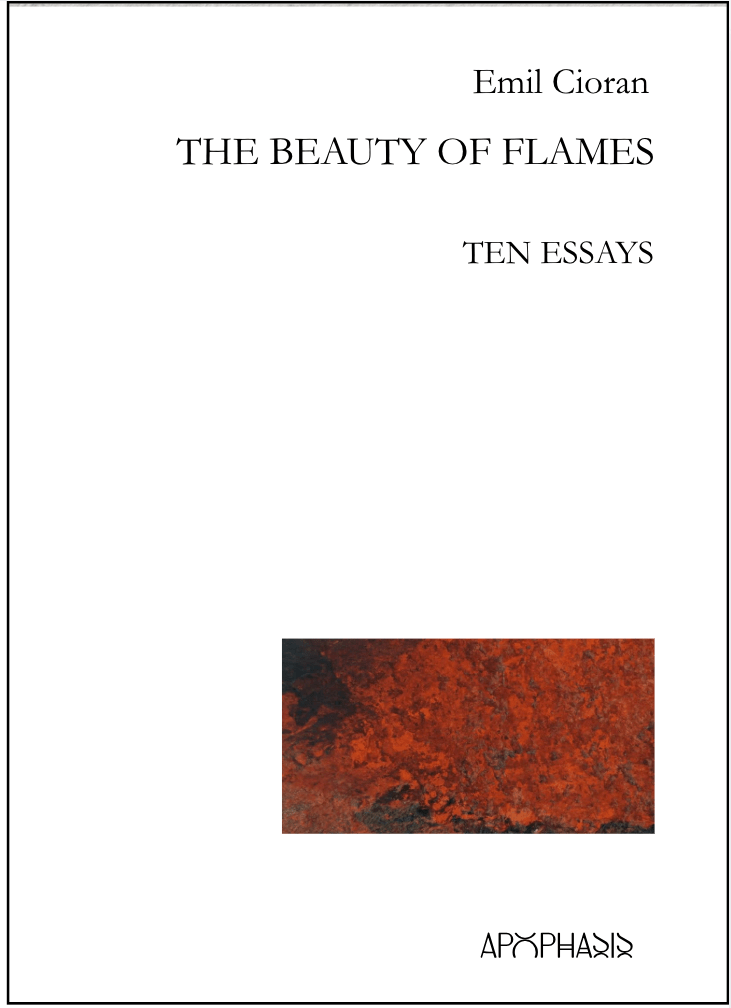
EMIL CIORAN
THE BEAUTY OF FLAMES: TEN ESSAYS
4.25 x 7.75 inch CORD-stitched booklet • 17 pages • $12 •ORDER
I would rather die of fire than of void
Romanian-born French essayist Emil Cioran (1911-1995) wrote in a clipped style, the better to breathe forth his fierce, feverish prose. These ten short essays are strange mutations that blend existentialist philosophy, autobiographical confession, and pure lyrical outburst. As a lifelong victim of extreme insomnia, Cioran habitually turns to examinations of sense and meaning, pain and suffering, joy and ecstasy, and the never-vanishing cloud of life’s futility. Rather than offering a systematic argument, Cioran assumes that an open-eyed despair, contrary to the ugly rumors, actually strips us of our delusions and enables a coruscating lucidity. How might life appear from this paradoxical vantage point from which our yearned for joy, meaning, and metaphysical comfort fade away, and yet…?
GEORG TRAKL
SACRED TWILIGHT: EIGHT POEMS
4.25 x 7.75 inch CORD-stitched booklet • 21 pages • $12 •ORDER new english translations FACING original German text
A wanderer steps silently within / Pain has turned the threshold to stone/ There, glowing in pure brightness /On the table: bread and wine
The poetry of Austrian Georg Trakl (1887-1914) is typically associated with Expressionism, or the presentation of the artist’s subjective experience. Virtually every word of a Trakl poem exudes a poignant, mournful melancholy. Poetry, he said, is an “imperfect penance” for “unabsolved guilt.” And, indeed, Trakl’s poems are suffused by a pantheistic religiosity as haunting and sublime as it is musical and vividly imagistic. As one critic says, Trakl “allows the images to speak for him,” even if “most of the images are images of silent things.”
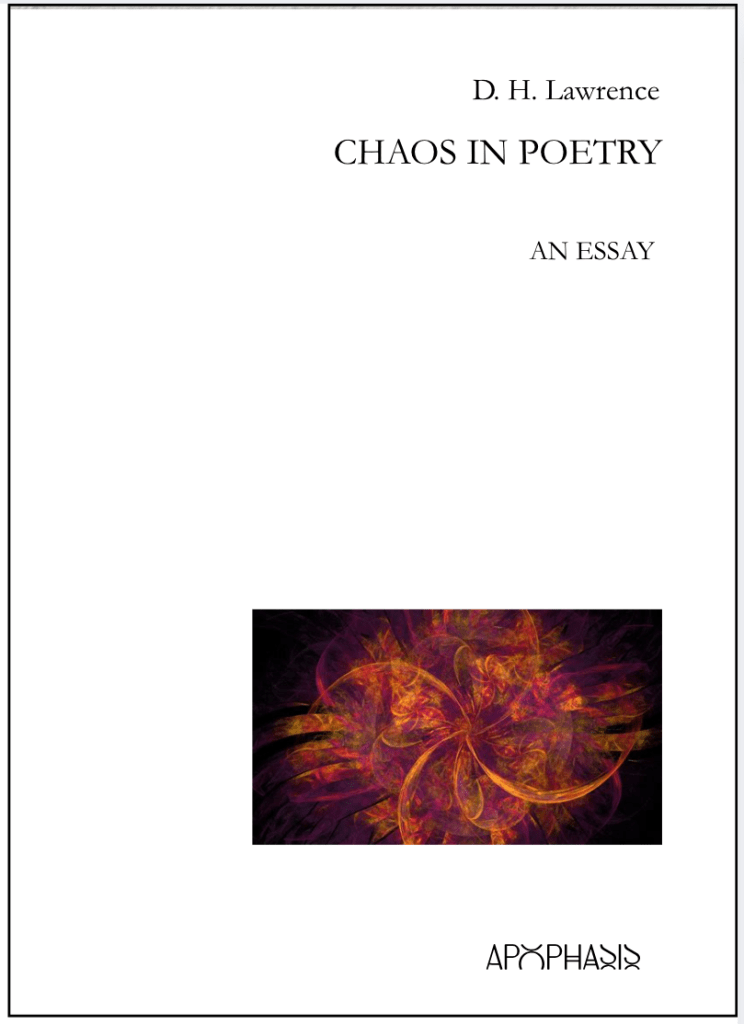
D. H. LAWRENCE
CHAOS IN POETRY: AN ESSAY
4.25 x 7.75 inch CORD-stitched booklet • 24 pages • $12 • ORDER
What is there, then, in this poetry, where there seems to be nothing?
“Chaos in Poetry” is writing that dazzles and burns with the very fire of wild creative energy to which it addresses itself. D.H. Lawrence (1885-1930) turns the impossible task of reviewing Harry Crosby’s amateurish poetry, a poetry that Lawrence says “means nothing and says nothing,” into a masterpiece of criticism — as unflinching in its critical assessment as it is deeply appreciative of the life-giving gift that Crosby’s hard-won, prophetically self-destructive poetry is: “chaos alive, not the chaos of matter…[but] a glimpse of the living, untamed chaos.”
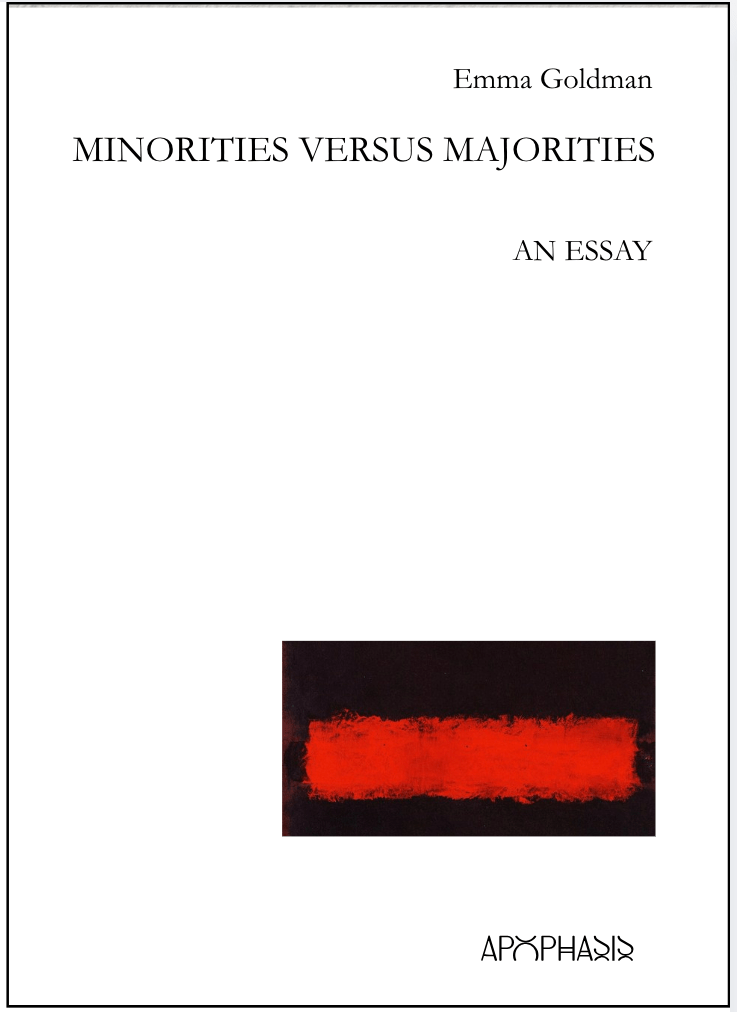
EMMA GOLDMAN
MINORITIES VERSUS AUTHORITIES: AN ESSAY
4.25 x 7.75 inch CORD-stitched booklet • 20 pages • $12 • ORDER
The living, vital truth of social and economic well-being will become a reality only through the zeal, courage, the non-compromising determination of intelligent minorities, and not through the mass
“”Minorities Versus Majorities” is anarchist Emma Goldman’s (1869-1940)) scathing condemnation of an American society that worships quantity over quality, vulgarity over intelligence, and spectacle over substance. No single person, but the mass, the majority, is to blame for our sorry condition. The majority is obedient, conformist, given easily to imitation and acceptance of the status quo. Humane change can come only from the minority, those who act not from automation but from conviction — thinkers, rebels, artists, and heretics. Humane change, in other words, will come from the untamed margins. .
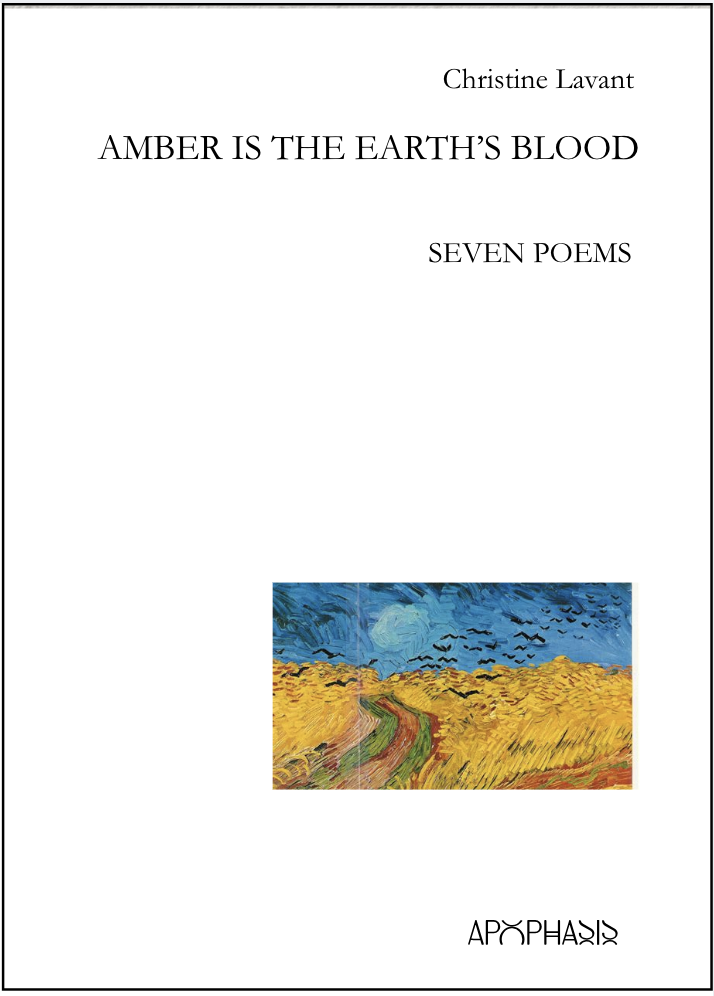
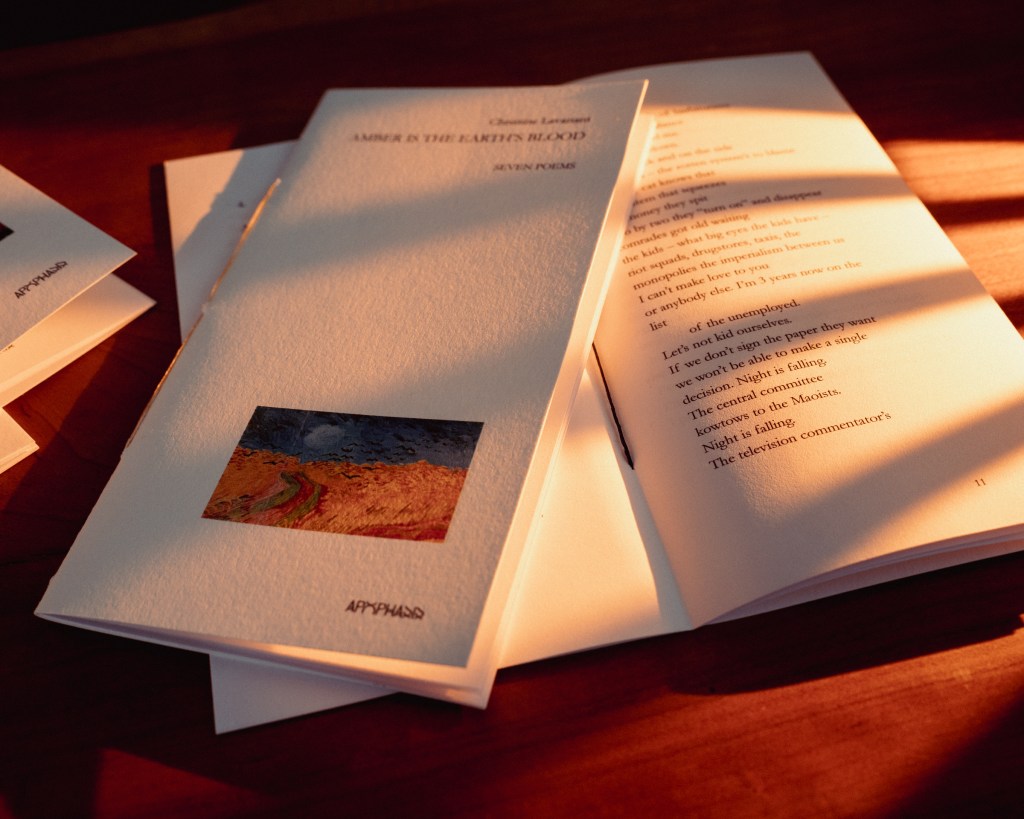
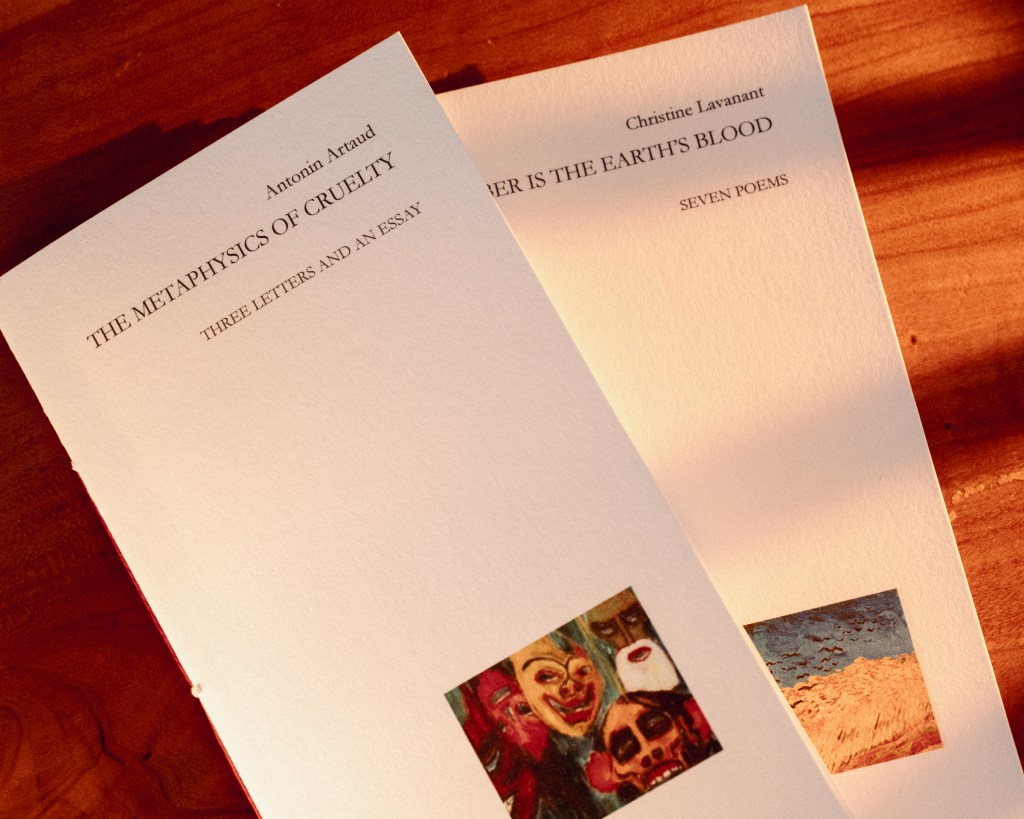
CHRISTINE LAVANT
AMBER IS THE EARTH’S BLOOD: SEVEN POEMS
4.25 x 7.75 inch CORD-stitched booklet • 17 pages • $12 •ORDER
Leaving my mood in the hands of the moon/brings me no closer to the solution
Although she won the Grand Austrian State Prize for literature and twice won the prestigious Georg Trakl Prize for poetry, Christine Lavant (1915-1973) remains virtually unknown outside of her native Austria. Lavant’s work is saturated by the tension wrought by a life of suffering, loneliness, and a mystical serenity. In direct, terse, and beautifully evocative language, Lavant writes about what she experienced most: damaged childhood, suffering women, poverty, social isolation, illness, and small-minded bigotry. Still, her work brims with the power of the creative will to craft art out of the harshness of life.
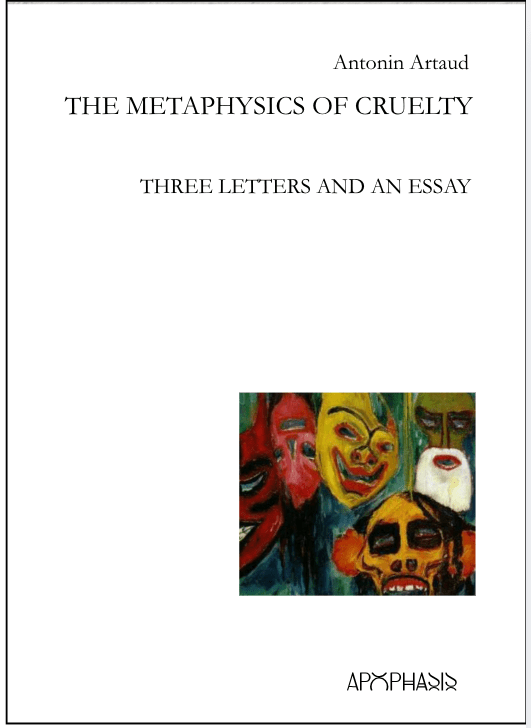
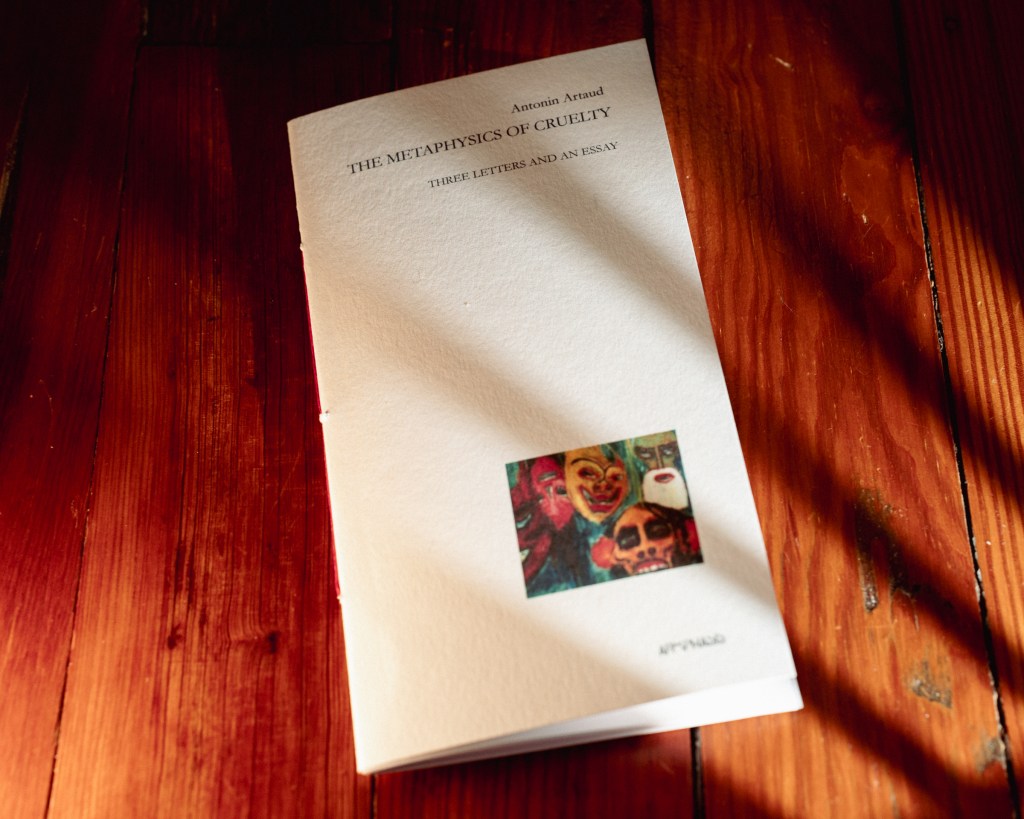
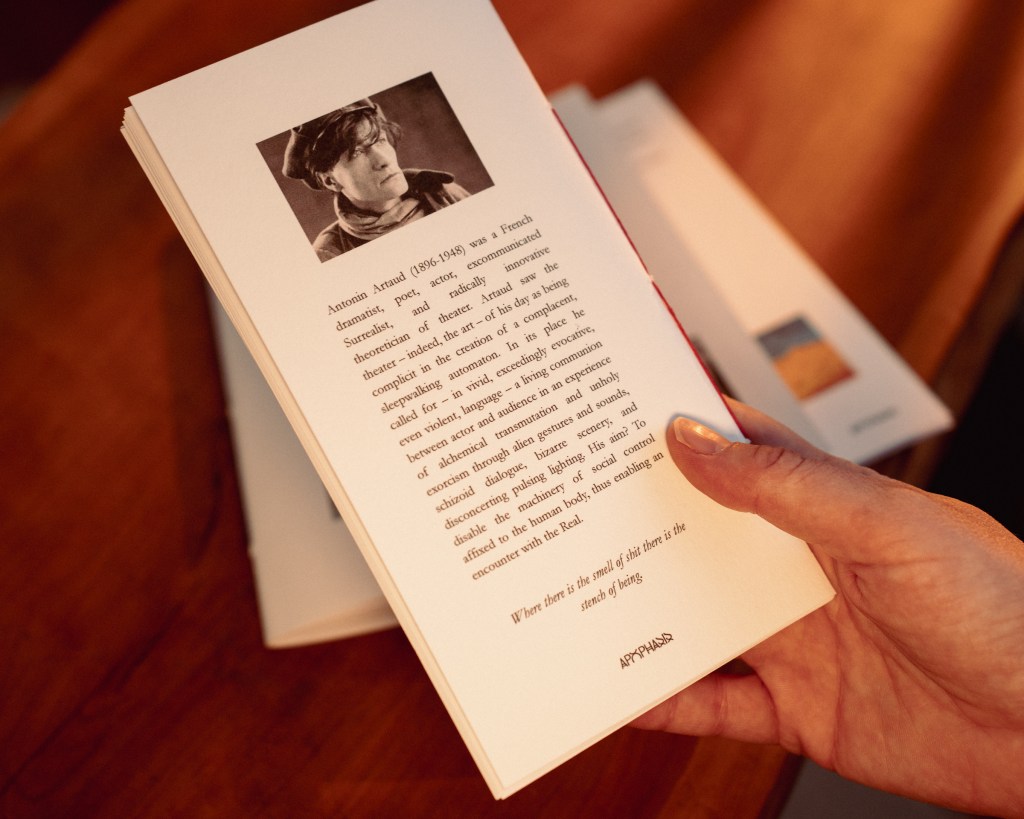
ANTONIN ARTAUD
THE METAPHYSICS OF CRUELTY: THREE LETTERS AND AN ESSAY
4.25 x 7.75 inch CORD-stitched booklet • 18 pages • $12 •ORDER
Where there is the smell of shit there is the stench of being
Antonin Artaud (1896-1948) was a French dramatist, poet, actor, excommunicated Surrealist, and radically innovative theoretician of theater. Artaud saw the theater — indeed, the art — of his day as being complicit in the creation of of a complacent, sleepwalking spectator. In its place he called for — in vivid, exceedingly evocative, even violent, language — a living communion between actor and audience in an experience of alchemical transmutation and unholy exorcism through alien gestures and sounds, schizoid dialogue, bizarre scenery, and disconcerting pulsing lighting. His aim? To disable the machinery of social control affixed to the human body, thus enabling an encounter with the Real.
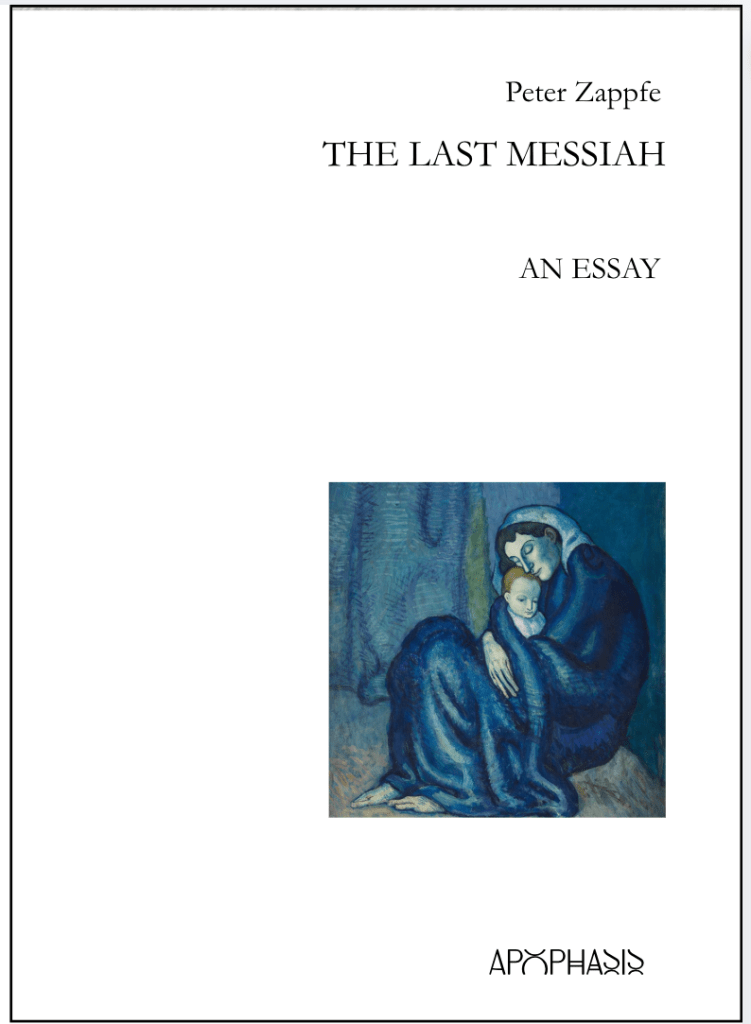
PETER ZAPFFE
THE LAST MESSIAH: AN ESSAY
4.25 x 7.75 inch CORD-stitched booklet • 32 pages • $12 •ORDER
One night in long bygone times, man awoke and saw himself
The Norwegian mountaineer and philosopher Peter Zapffe (1899-1990) saw in our overabundance of consciousness a human, all-too human tragedy. “Man is a tragic animal. Not because of his smallness, but because he is too well endowed. Man has longings and spiritual demands that reality cannot fulfill. We have expectations of a just and moral world. Man requires meaning in a meaningless world.” Though universally viewed as pessimistic, might not such a view bring us closer to a clear-eyed, life-affirming, amor fati?
FRIEDRICH HÖLDERLIN
TINIAN: A POEM
4.25 x 7.75 inch CORD-stitched booklet • 24 pages • $12 •ORDER new english translation FACING original German text
Sweet it is to be nourished by the beauty of the world
The Greek island of Tinos (Tinian is the demonym) is a richly symbolic location for Friedrich Hölderlin (1770-1843). As in his novel Hyperion, in “Tinian” the island mainly represents a harmonious dwelling that precedes worldly alienation. Yet, given the historical role of the island as a place of refuge for the persecuted, it also bears a sense of haven in the midst of danger. “Tinian,” is translated as a whole into English for the first time here.
KATERINA GOGOU
THEY WILL COME: SEVEN POEMS
4.25 x 7.75 inch CORD-stitched booklet • 17 pages • $12 •ORDER
What is important is to remain human
Katerina Gogou (1940-1993) was a Greek poet, actress, and activist. Her life was plagued by her childhood experiences under the brutal Nazi occupation of Greece. Identifying with the marginalize, the damned, and the condemned of Athens, Gogou took on the mantle of poetic voice of the working class anarchist neighborhood of Exarcheia. Yet, even among hardcore leftists, Gogou’s ferocious, scathing, and uncompromising poetry frightened many and left her alienated. Gogou committed suicide at the age of 53: “I was a tree and I broke.”
JAMES BALDWIN
THE ARTIST’S STRUGGLE FOR INTEGRITY: ATALK
4.25 x 7.75 inch CORD-stitched booklet • 20 pages • $12 •ORDER
The artist’s struggle for integrity is a metaphor for the struggle of all human beings on the face of this globe to get to become human beings
James Baldwin (1924-1987) argues that “the artist’s struggle for integrity is a metaphor for the struggle of all human beings on the face of this globe to get to become human beings.” Still, unlike the multitudes who do not engage in the wprk of art, the artist has a special task, burden really, “to ask very hard questions and to take very rude positions.” The artist does this by dint of his or her ability to see and courage to articulate what is seen. Originally delivered extemporaneously, it seems, to a gathering at the Community Church in New York City, “The Artist’s Struggle for Integrity” brims with Baldwin’s oratorical brilliance.
MIKHAIL BAKUNIN
WHAT IS AUTHORITY? AN ESSAY
4.25 x 7.75 inch CORD-stitched booklet • 20 pages • $12 •ORDER
There is no fixed and constant authority
The question is as vital today as in the fraught times of Mikhail Bakunin (1814-1876). Because he is a self-avowed radical revolutionary anarchist, Bakunin too often gets short shrift as a thinker to be taken seriously. Yet, we challenge any reader to refute the sober argument of “What is Authority?” Who can deny, for instance, that ostensibly independent-minded thinkers, once employed by authority-granting “scientific academies,” including our universities, lapse into an insipid “politeness” that amounts to a moral and intellectual “corruption”? Expecting even less from the institutionally-bestowed authority of politicians, Bakunin challenges us readers to maintain our “troublesome and savage energy” in determining who and what deserves the (always temporary) badge of “Authority.”
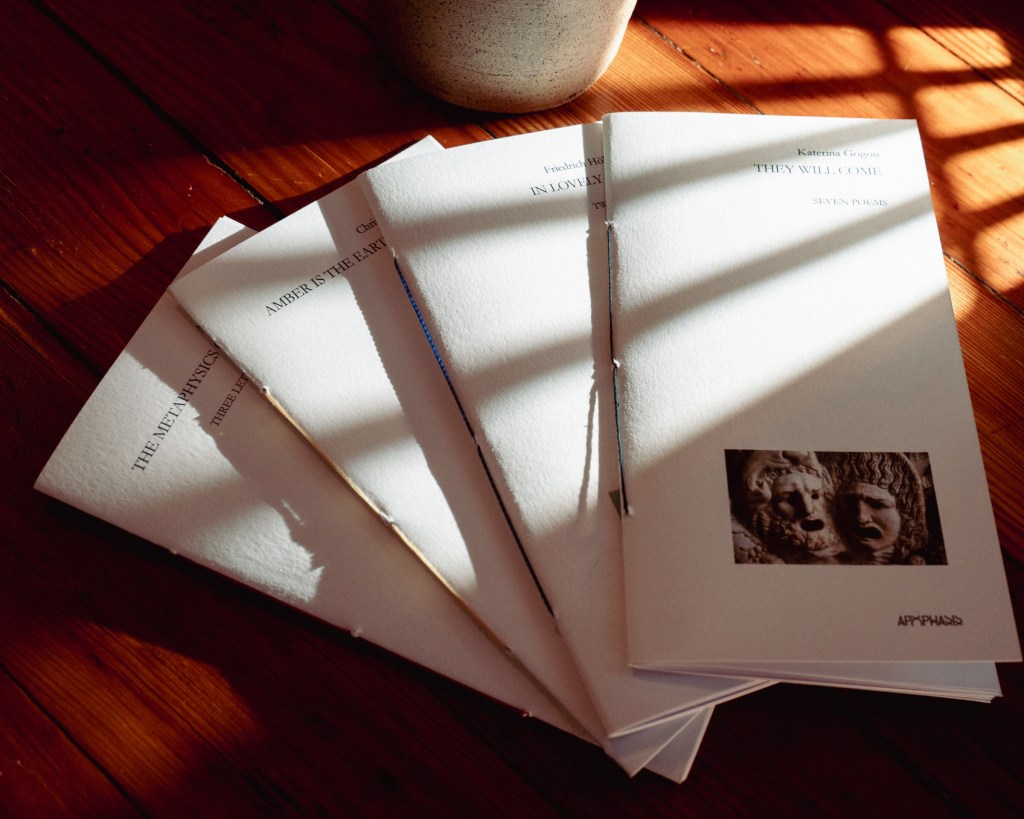
Booklets ARE
4.25 in. wide x 7.75 in. long
Printed on white woven 100% cotton 24-pound paper
Covered with 135-pound 50% cotton Italian cover stock
Side-stitched with varying colored Brazilian waxed hemp cord
(Photo credit: William Knight and Liam Knight)
The Spirit of Apophasis
We humans are homo scribens, the being who writes. It is an odd behavior, writing. No other being does it. So why do we?
Here’s how we see it. We humans write to engage, to a heightened degree, our hope, fear, and anxiety. We write driven by anger, love, joy, and sadness. We write catalyzed by longing and a gnawing vague nostalgia. We write to make sense of things, to understand what has happened. Above all, we write in search of a path to the horizon — the horizon of a saving knowledge; the horizon of a final, fulfilling, word; the horizon of pleasure unalloyed.
But wait! This is a horizon that language is incapable of meeting. Recognizing the impossibility wrought by the very act of naming, apophasis breathes into our words a spirit of silence, a quiet pause, that is vivifying.
“Apophasis” means saying, however haltingly, what cannot be said. In mystical theology apophatic language is a strategy that arises out of a deep suspicion that our forms of expression are incapable of articulating the matters that are, or that perhaps should be, most important to us. Mystical apophatic language nonetheless stammers and stutters in the spirit of such articulation. Apophatic utterance is a futile prayer pitted with holes, yet uttered nonetheless.
We may also speak of a literary apophasis. Samuel Beckett is to this tradition what Pseudo-Dionysius the Areopagite is to the mystical, as when Beckett says, “To drill one hole after another into language until that which lurks behind, be it something or nothing, starts seeping through — I cannot imagine a higher goal for today’s writer.”
One of the most exquisite displays of literary apophaticism is Paul Willems’s story “The Cathedral of Mist.” In this church made of mist rather than of stone:
“prayer took on a great fervor because it was not expressed in words…a kind of mute rapture seized you. You became silence. No voice rose up, not even from the deepest part of yourself. Your whole being went in an intense leap toward something — but what? Not any goal that could be put into words, nor the fulfillment of any desire, nor a battle, nor consolation. You went toward something you did not know the nature of. Toward everything. Toward nothing.”
Everything and nothing. Speech and silence. Stone and mist. Language in ruins. Meaning at the brink. And yet…and yet…





 Apophasis